
Covers-Per-Shift Math: When an Azenco Pergola Pays Back an Austin Patio
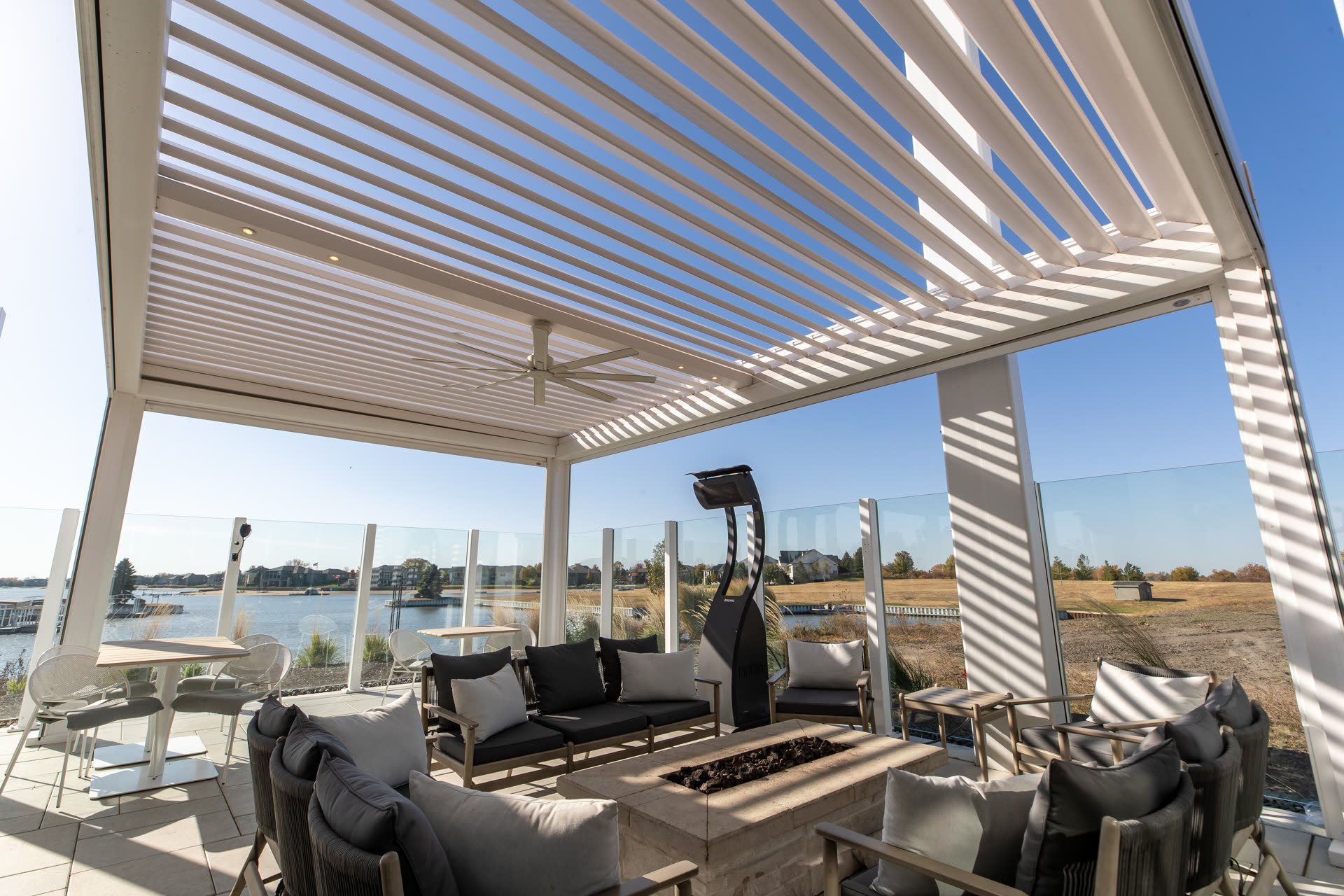
Austin restaurant and hotel operators do not need to be convinced that a covered patio outperforms an unshaded one. The question is always the same: what does the payback actually look like against the capital cost of a specification-grade louvered pergola? This is the numbers-only version of that conversation.
Start with covers per shift, not square footage
The right unit of measurement for hospitality patio ROI is covers per shift — the number of guests served in a service window — not seat count or square footage. An unshaded patio is measured by peak capacity. A covered patio is measured by usable hours multiplied by turnover.
An uncovered south- or west-facing patio in Austin is functionally unusable during the July and August 2:00–7:00 p.m. window. That is the highest-margin part of the day for a full-service restaurant. Recover those hours and the shift-level economics change materially.
The math, spelled out
Assume a 24-seat patio, average check of $45 per guest, and 1.6 turns per usable shift. Restaurant Association benchmarks put average net income for full-service restaurants at roughly 3–5 percent of gross revenue (National Restaurant Association).
- Unshaded, summer: 24 seats × 1.6 turns × $45 × 3 usable dinner shifts/week ≈ $5,184/week gross from that patio.
- Covered with rotating louvers, summer: 24 seats × 1.6 turns × $45 × 6 usable shifts/week (adds lunch + expanded dinner window) ≈ $10,368/week gross.
The delta is roughly $5,000 per week in incremental gross summer revenue — and that is before rain-day recovery, which the bioclimatic louver system also captures because the roof closes for weather. Over a 20-week Central Texas peak season, the delta approaches $100,000 in gross summer revenue attributable to shading.
Rain-day recovery matters more than operators realize
Central Texas averages more spring and summer thunderstorm days than the interior Southwest. NOAA precipitation data for Austin shows a bimodal distribution with meaningful precipitation frequency in May and September (NOAA National Weather Service Austin/San Antonio). An unshaded patio evacuates on the first drop. A louvered pergola closes, the patio stays open, and the restaurant does not lose the shift.
Capital cost against payback horizon
A specification-grade motorized louvered pergola on a commercial patio in the 400–800 sq ft range is a capital investment, not an operating expense. The category typically depreciates over a 5–7 year horizon under commercial tax treatment (IRS Publication 946). On a $50,000 installed cost, an incremental $100,000/season in gross revenue at 4 percent net margin returns $4,000/season in operating profit — and the covers-per-shift lift compounds year over year, not just in year one.
The payback horizon on an aluminum louvered pergola is a function of two variables: the operator's baseline patio revenue and the number of hours per year the patio was previously unusable. Both are testable numbers on any specific site.
Integrated accessories change the annualized number
The covers-per-shift analysis above assumes summer alone. Central Texas operators who specify integrated overhead LED lighting, ceiling fans, and infrared heaters convert the same patio into a four-season revenue asset. Winter dinner service on a shielded, heated patio in January and February adds another 8–12 usable shifts per month at a full-service Austin restaurant.
The accessories mount to the same aluminum frame that carries the louvers, so the electrical rough-in and structural load path are handled once. There is no second contract for lighting or a separate infrared heater install after the fact.
Why the aluminum louver assembly, not a cheaper alternative
A shade sail is not a substitute. Fabric cannot close for weather, cannot survive a Central Texas gust front, and cannot be integrated with lighting, fans, and heaters. A solid roof creates a heat trap that reduces perceived comfort under it. The Azenco R-BLADE is the middle ground: it stops direct beam radiation, it closes for rain, it vents convectively when louvers are angled, and it accepts integrated hospitality accessories on the same structure.
The 190 mph wind rating and Miami-Dade NOA structural certification also matter for insurance underwriting on a commercial property. Underwriters look at wind and impact resistance on any patio structure attached to or adjacent to a rated building envelope (Azenco Outdoor).
Where CCSI fits
Construction Component Sales Inc. is the CCSI-side Azenco representative for commercial hospitality projects. On a covers-per-shift ROI analysis, that means the specification, engineering, and installation coordination arrive as a single deliverable rather than three separate scopes the restaurant group has to manage. See the full CCSI pergolas product line.
Frequently asked questions
What patio size does the covers-per-shift math work at?
The math scales linearly with seat count. The threshold for a positive commercial case is typically 16–20 covers or more on the patio, because fixed engineering and installation costs on a smaller structure erode the shift-level revenue lift.
Does the operator need to close the whole roof for rain?
Yes for rain, and it happens automatically if an optional rain sensor is specified. The louvers rotate to a closed position and integrated concealed gutters route water through the posts to grade.
Can the pergola be built over an existing patio?
Usually yes. The anchorage engineering package covers slab-mount, deck-mount, and knee-wall attachment. The specification confirmation happens with the existing slab or structure drawings in hand.
How is the covers-per-shift number verified on a specific project?
With historical POS shift-by-shift data. Operators typically pull the last two summers of patio-service revenue by shift and identify the hours that were closed for weather or heat — those are the recoverable shifts.
Looking for a product or a quote?
Tell us about your project and we'll help you source the right building product.