
Retrofitting Multifamily and HOA Portfolios: Swapping Traditional Gutter Guards for Sasquatch

Texas multifamily and HOA portfolios are quietly moving off traditional gutter guard products — not in a single portfolio-wide swap, but building by building, on renewal and repaint cycles. The economics are simple. Traditional drop-in guards sag under debris load, deform under thermal cycling, and force the maintenance crew to reset them every year. Sasquatch's hangerless install path fits the retrofit window on a working portfolio without asking the board or the property manager to shut down operations.
Why the retrofit conversation is happening now
Three drivers are converging in Texas commercial and HOA portfolios:
- Original guards are aging out. Traditional gutter guards installed on Texas multifamily buildings during the 2010s construction boom are now 10–15 years old. Aluminum fatigue, spring-clip failure, and hanger deformation are visible on inspection.
- Debris loads are higher. Pine, oak, and mesquite canopies over multifamily amenity zones and HOA common areas drop more debris than the original design load anticipated. Gutter cleaning frequency has doubled on many properties.
- Insurance underwriters are asking questions. Post-storm inspections on Texas commercial and multifamily properties increasingly flag gutter edge condition as a maintenance signal (Insurance Information Institute).
Each of those individually is a maintenance line item. Together they are the trigger for a portfolio-level specification review.
What the hangerless retrofit path actually looks like
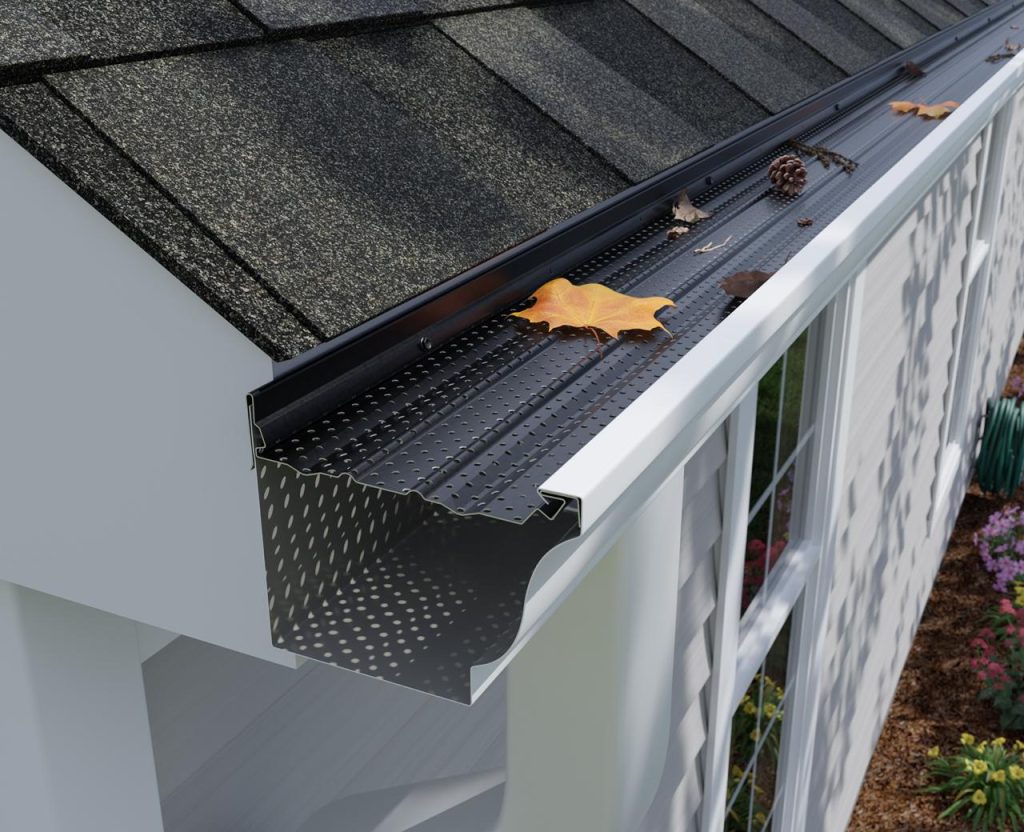
The Sasquatch install path removes the two failure modes that make traditional guards a recurring maintenance cost. The front edge locks into the existing gutter's front hem; the back edge attaches directly to the fascia via the patent-pending rear screw ledge (E-Z Gutter Guard). No internal hangers. No spring clips. No dependence on the gutter's own hanger schedule.
On a retrofit, that translates into a predictable install workflow: remove the old guard, verify the gutter's front hem is intact, install Sasquatch on the same run. The gutter itself is not touched unless the existing gutter is failing. The install crew is on the fascia line rather than working from inside the gutter, which shortens crew time per linear foot on a working building.
The portfolio economics
Multifamily and HOA maintenance budgets typically carry a gutter cleaning line item at $150–$300 per building per cleaning, two to four cleanings per year depending on canopy exposure. On a 40-building portfolio, that is $12,000–$48,000 per year in gutter cleaning alone. Add periodic guard replacement, hanger reset labor, and post-storm inspection costs and the annual gutter-related operating spend can exceed $80,000 on a mid-size portfolio.
A Sasquatch retrofit shifts the maintenance profile from internal excavation to top-surface rinses. Portfolio-wide standardization on a single product line also compresses the specification and warranty administration — one submittal, one warranty document, one maintenance protocol briefed to every crew (Multifamily Executive).
The transferable warranty is a disposition asset
Sasquatch's lifetime limited warranty is transferable. On a multifamily property that trades every 5–7 years, that matters at disposition. The buyer's due-diligence checklist includes gutter and roof-edge condition; a transferable warranty on a documented specification is a small but real disposition asset that removes a punch-list item from the trade.
Sequencing the retrofit across a portfolio
Timing matters as much as the product decision. A retrofit executed on the wrong cycle costs more than the product itself; done on the right cycle, the incremental labor is close to zero. Two sequencing patterns work in Texas:
- Renewal-cycle retrofit. Convert one building per insurance renewal cycle. Prioritize buildings with the highest recent gutter-related maintenance spend or the most exposed canopy.
- Repaint-cycle retrofit. Bundle the gutter guard swap with the exterior repaint. The staging is already there, the fascia is already accessible, and the incremental crew cost is small relative to the standalone install.
A third pattern applies to post-hail claims. When roof edges are being inspected and repaired after a storm event, the marginal cost of upgrading to a Sasquatch specification during that window is low compared to a standalone retrofit six months later. Property managers in the DFW and Central Texas hail corridors bundle this decision into the storm-response workflow rather than treating it as a separate capital line item.
Where CCSI fits
Construction Component Sales Inc. is the CCSI-side representative for Sasquatch retrofits across Texas multifamily and HOA portfolios. On a portfolio-scale retrofit, that means the submittal, sequencing plan, and warranty documentation arrive packaged for the community manager or asset manager — not scattered across three separate vendor conversations. See the full CCSI E-Z Gutter Guard product line.
Frequently asked questions
Does the retrofit require replacing the gutters themselves?
Not unless the existing gutter is failing. Sasquatch locks into the existing front hem and attaches to the fascia. The gutter stays.
Can the retrofit happen while the multifamily property is occupied?
Yes. The install is a fascia-line operation and does not require closing amenity areas or unit access. Crews sequence by building or by wing.
Is the transferable warranty automatic on portfolio buildings?
Yes. The lifetime limited warranty transfers to the next owner without a separate assignment step, which matters on multifamily properties that trade on a 5–7 year cycle.
How is a portfolio-scale retrofit priced?
On linear footage across all buildings, with volume pricing on multi-building commitments. Send building count and total roof-edge linear footage on the contact form for a scoped submittal.
Looking for a product or a quote?
Tell us about your project and we'll help you source the right building product.