
Warehouse and Big-Box Retail Install Economics: The Sasquatch Labor Math on Long Roof Edges
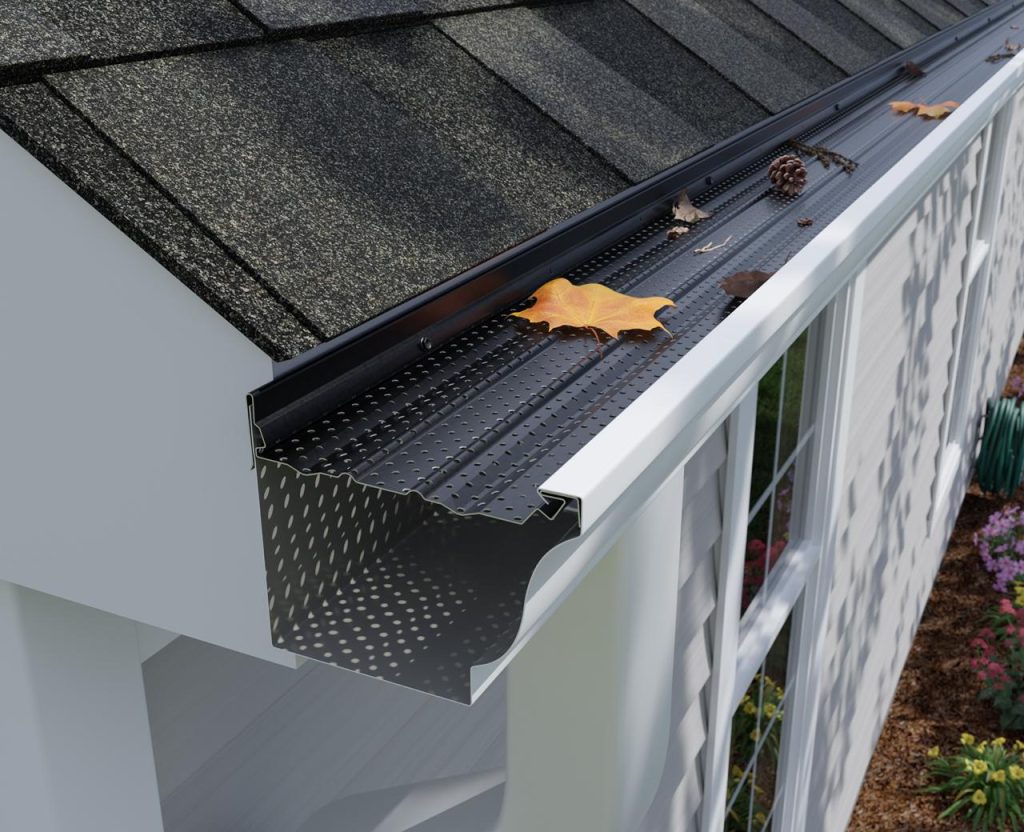
On a warehouse or big-box retail roof edge, gutter protection is a per-linear-foot decision. A single big-box footprint can carry 1,000+ linear feet of gutter along the eaves. That length is where the difference between hangerless and traditional gutter guard install economics stops being theoretical.
Why hangerless matters at scale
The core Sasquatch design difference is documented on the manufacturer specification: locks into the gutter front hem, secures via a rear screw ledge into the fascia, and attaches directly without touching gutter hangers (E-Z Gutter Guard). At 100 linear feet of gutter, the labor difference between hangerless and per-hanger install is measurable but modest. At 1,000+ linear feet, it becomes the dominant install-cost variable.
The linear-footage problem
A 200′ × 400′ warehouse footprint runs 1,200 linear feet of roof edge. A big-box retail store at 100′ × 200′ runs 600 linear feet. Multiply across a portfolio of 20+ locations and total linear footage passes 15,000 feet quickly.
Every install step that takes an extra 30 seconds per foot adds up: at 15,000 linear feet, that is 125 person-hours of added labor. At Texas commercial installation labor rates — typically $65-$95 per hour for skilled gutter labor including benefits and vehicle overhead — that added labor represents $8,000-$12,000 in labor cost per portfolio (U.S. Bureau of Labor Statistics OES data for construction laborers).
Where Sasquatch changes the labor math
The Sasquatch hangerless design eliminates three install steps that traditional gutter guards require:
- No hanger drilling or clip attachment. Traditional guards mount to gutter hangers, which either replaces existing hangers or drills new attachment points. Sasquatch locks into the gutter front hem and secures via a rear screw ledge into the fascia — no hanger interaction.
- Faster per-section install. The 7.5′ standard sections lock in and screw down in a documented cadence, which is why installers report significantly higher linear-feet-per-day rates on long straight runs compared to per-hanger systems.
- Fewer callback trips. The transferable lifetime limited warranty and the hangerless design reduce the warranty-callback rate on properties that see wind uplift or thermal cycling on the guard-to-hanger connection.
The specification conversation for property portfolios
On a multi-location warehouse or retail portfolio, the specification conversation typically starts with product-level unit cost. That is the wrong metric. The right metric is fully-loaded cost per linear foot, which includes:
- Product cost per foot
- Install labor per foot at Texas commercial rates
- Expected callback labor over the first 5 years
- Ongoing gutter cleaning cost per year (linear-foot based)
Traditional guards win on product-cost line 1. Sasquatch wins on lines 2, 3, and 4 — especially on properties with high linear-foot totals where cleaning cost avoidance compounds year over year (Mechanical Contractors Association of America).
Portfolio standardization as a secondary benefit
Big-box retail and warehouse operators typically manage 20-100+ locations. Specifying a single gutter protection SKU across all locations — Sasquatch 6″ in .019″ standard or .022″ Arctic Extreme for coastal/WUI — means portfolio inventory reduces to two variants. Regional maintenance vendors carry that single SKU on the truck instead of a rotating catalog of guard types matched to each location's original install.
The transferable lifetime limited warranty adds a portfolio-level benefit: when a location is sold to another operator, the warranty follows the property. On a portfolio where locations rotate through operators every 5-10 years, that transferability is worth several thousand dollars per location on the disposition side.
Coordination with the roofing GC
On a new commercial roof install or a re-roof, the Sasquatch spec goes on the initial submittal. The roofing GC coordinates the gutter guard install with the primary gutter install and the fascia detail. Retrofitting Sasquatch onto an existing gutter without an active roofing project is workable, but the economical path is to bundle it with a re-roof or a re-gutter cycle.
Access, staging, and safety on long roof edges
Long roof edges on warehouses and big-box retail introduce access variables the specification should acknowledge upfront:
- Boom lift vs. scissor lift. Continuous straight runs favor scissor lifts because the crew can position once and screw down a long section. Corner or step-back roof geometry may require a boom.
- Ground conditions for lift access. On a stabilized-gravel loading yard, lift positioning is straightforward. On a fresh landscape strip or unimproved perimeter, lift positioning adds a mat or plywood step.
- Overhead line clearance. Utility service drops and low-voltage low-hanging cabling constrain lift positioning. The specifier should walk the perimeter with the electrical drawings before scheduling.
These are not Sasquatch-specific variables; they apply to any gutter-protection install on long commercial roof edges. But they belong in the specification package so the install schedule and lift-day pricing come in at real numbers rather than optimistic ones.
Where CCSI fits
Construction Component Sales Inc. is the CCSI-side Sasquatch representative for Texas commercial and portfolio projects. On a multi-location specification, that means the linear-foot pricing, thickness selection, and installer coordination arrive as a single quote package — not per-location one-off pricing. See the full CCSI E-Z Gutter Guard product line.
Frequently asked questions
How many linear feet per day does a two-person crew install on Sasquatch runs?
On long straight commercial runs, two-person crews report significantly higher linear-feet-per-day rates than per-hanger systems because there is no hanger interaction step. Actual daily rates vary by roof edge access and staging.
Does the 6-inch or 5-inch profile fit big-box retail gutters?
Most big-box retail and warehouse buildings use 6-inch commercial gutters, which match the Sasquatch 6-inch profile. Older or smaller-footprint retail can be on 5-inch, which also has a Sasquatch match.
Does the transferable warranty really move with the property?
Yes. The lifetime limited warranty transfers with the property to a new owner. On a portfolio with location turnover, this is a documented benefit on the disposition side.
Should the specification default to .019-inch or .022-inch aluminum?
Default to .019-inch standard for most inland Texas commercial. Upgrade to .022-inch Arctic Extreme for coastal, WUI-mapped, or high-hail-exposure locations.
Looking for a product or a quote?
Tell us about your project and we'll help you source the right building product.